Ringworm is a fairly common skin disorder, especially among children, although it does afflict people of all ages. It is estimated that, at any given time, twenty percent of the population is infected with ringworm. For a successful ringworm treatment, it is important for us to learn about its causes, symptoms, methods of prevention, and related current medicinal practices.
This site aims to provide you with detailed, accurate, and well-sourced information regarding ringworm and ringworm treatment. You can access the specific information that you need by clicking on the links below:
Ringworm Treatment - An Overview
A brief introduction to help you identify certain aspects of this skin condition you might want to study.
Causes of Ringworm
Discusses the causes of this infection, how it develops, and under what conditions it multiplies rapidly.
Risk Factors
Explains how contagious nature of ringworm, who are highly at risk of contracting the disease, and how it is normally transmitted.
Symptoms of Ringworm
Informs in detail the specific symptoms of ringworm and how your doctor will diagnose the condition.
Ringworm Self Treatment
Provides detailed information about ringworm treatment, drugs normally used in home-care or self-care medication, alternative ringworm cure, and when it is best to contact a medical professional.
Ringworm Prevention
Discusses the basic steps in preventing ringworm, also explains the need to treat infected household pets, prevention habits, and areas and conditions you need to be wary of.
Ringworm Treatment for Children
A must-read for every parent who would like to learn about the best method of ringworm treatment for his or her child. Detailed, well-researched, and reliable information on treating ringworm in our children.
What Does Ringworm Look Like?
A picture educates more than a thousand words can. This collection of ringworm pictures, borrowed from the Public Health Image Library of the Centers for Disease Control and Prevention (CDC), does just that.
What does ringworm look like
Ringworm is a fairly common skin disorder, especially among children, although it affects people of all ages. It's not caused by any worm, but by mold-like fungi called dermatophytes. It commonly appears as reddish-colored circular lesions with scaly raised edges.
Below are pictures of ringworm, provided by the Centers for Disease Control and Prevention (CDC) in their Public Health Image Library (PHIL):

Ringworm of the scalp (tinea capitis) – this infection, which affects the scalp and the hair deep into the roots, is highly contagious and persistent. Ringworm of the scalp, almost exclusively, affects children between the ages of 2 to 10. Symptoms may include itching, flaking or scaling (dandruff), small infected bumps, and hair loss. The infected child may have areas that appear bald due to premature hair loss, and there may be small black dots on the exposed scalp.
Ringworm of the scalp (tinea capitis) is difficult to treat and may require several months of oral antifungal medication. Call your doctor if you or your child has ringworm of the scalp. Homecare ringworm treatment is not very effective in curing tinea capitis.

Ringworm picture above shows a large, tender, swollen, pus-filled lesion called "kerion." This is a complication in ringworm of the scalp believed to be caused by a child's hypersensitivity to the ringworm, may be associated with rash elsewhere in the body and tender lymph nodes in the neck. Ringworm of the scalp has been observed to disappears spontaneously at puberty.

The picture above shows a rare case of “Tinea faciei,” or ringworm infection of the face caused by a dermatophytic fungus, but not including infection of the bearded areas., which are called “tinea barbae”.

Pictures above show ringworm of the body (tinea corporis) occurring in the am and leg

Ringworm of the feet (tinea pedis) or "athlete's foot." Ringworm symptoms may appear in the moist areas between your toes and sometimes on your foot itself.
Below are pictures of ringworm, provided by the Centers for Disease Control and Prevention (CDC) in their Public Health Image Library (PHIL):
Ringworm of the scalp (tinea capitis) – this infection, which affects the scalp and the hair deep into the roots, is highly contagious and persistent. Ringworm of the scalp, almost exclusively, affects children between the ages of 2 to 10. Symptoms may include itching, flaking or scaling (dandruff), small infected bumps, and hair loss. The infected child may have areas that appear bald due to premature hair loss, and there may be small black dots on the exposed scalp.
Ringworm of the scalp (tinea capitis) is difficult to treat and may require several months of oral antifungal medication. Call your doctor if you or your child has ringworm of the scalp. Homecare ringworm treatment is not very effective in curing tinea capitis.
Ringworm picture above shows a large, tender, swollen, pus-filled lesion called "kerion." This is a complication in ringworm of the scalp believed to be caused by a child's hypersensitivity to the ringworm, may be associated with rash elsewhere in the body and tender lymph nodes in the neck. Ringworm of the scalp has been observed to disappears spontaneously at puberty.
The picture above shows a rare case of “Tinea faciei,” or ringworm infection of the face caused by a dermatophytic fungus, but not including infection of the bearded areas., which are called “tinea barbae”.
 |
| Tinea barbae or ringworm of the bearded area |
Pictures above show ringworm of the body (tinea corporis) occurring in the am and leg
Ringworm of the feet (tinea pedis) or "athlete's foot." Ringworm symptoms may appear in the moist areas between your toes and sometimes on your foot itself.
Ringworm Treatment for Children
As a parent, there are a few things you need to know before you begin a home-care ringworm treatmentprogram for your child. It would be downright useless administering ringworm cure based on limited information - only to find out a few weeks later that your child didn't have ringworm, in the first place; Or that the over-the-counter ointment that you've been using was not the best choice for treating the infection.
Below are some pictures of ringworm affecting different parts of the body of some children.

To see more ringworm pictures please click here.
Is it contagious? How did my child get it?
Yes, ringworm is highly contagious, especially ringworm of the scalp (tinea capitis). It can be transmitted through direct skin contact with:
You must find out whenever possible, where the source of the infection was, and take the necessary action to prevent your child from getting infected again, in the future. Unlike pets, which can develop autoimmunity after about 4 months of infection (even without treatment), your child faces the constant risk of being infected with ringworm, again and again.
What parts of the body are usually affected?
Among children, there are four parts of the body that are usually infected with ringworm. Don't get intimidated by the Latin names, doctor use them simply to describe which part of the body the ringworm is located. These areas include:
Treating mild cases (a patch or two) of ringworm of the body, the feet, and the groin can be done at home. Dr. B.D. Schmitt, author of "Your Child's Health," (Bantam Books) suggests the following over-the-counter antifungal creams or sprays:
Any of these medications are quite effective in the treatment of ringworm in your child. Ringworm usually responds well to homecare medications within 3 to 4 weeks.
Tinea Capitis
On the other hand, ringworm of the scalp (tinea capitis) is difficult to treat and may require several months of oral antifungal medication. Call your doctor if your child has ringworm of the scalp. Homecare ringworm treatment is not very effective in curing tinea capitis.
Because the scalp ringworm infection is deep down in the hair roots, your child must take medicine by mouth in order to cure it. Your doctor will prescribe a medicine by mouth to be taken daily with fatty foods such as milk, yogurt or ice cream, to increase absorption.
Treatment for scalp ringworm may include:
Oral Medication like –
How do I prevent my child from getting infected with ringworm?
Like they always say "prevention is better than cure." The same goes with ringworm, if your child don't have it, try your best for him or her not to have it.
In truth, ringworm is difficult to prevent because the fungi that cause this infection can be found practically anywhere. However, if you take some basic steps, ringworm infection can be prevented. Always encourage your child to:
What is ringworm?
Ringworm is a common infection caused by mold-like fungi called dermatophytes. These are microscopic organisms that live in the soil, in animals, and yes, on the outermost layer of your skin. These fungi thrive in warm, moist environment, and in parts of the body that are often wet or moist from perspiration. Your child, as cited in Children's Hospital (Boston) article on ringworm, increased risk of being infected with ringworm if he or she:- is malnourished
- has poor hygiene
- lives in a warm climate
- has contact with other kids or pets that have ringworm
- is immunocompromised by disease or medication (this simply means that the child has a lowered resistance to infections due to diseases, like AIDS or diabetes, or medication)
Below are some pictures of ringworm affecting different parts of the body of some children.
 |
| a child with ringworm |
Is it contagious? How did my child get it?
Yes, ringworm is highly contagious, especially ringworm of the scalp (tinea capitis). It can be transmitted through direct skin contact with:
- an infected person
- an infected pet
- an infected object (like brush, hats, towels, clothes, exercise mats)
- or contact with surfaces (like in gyms, public baths, public swimming pools) that have had direct contact with an infected person or pet
You must find out whenever possible, where the source of the infection was, and take the necessary action to prevent your child from getting infected again, in the future. Unlike pets, which can develop autoimmunity after about 4 months of infection (even without treatment), your child faces the constant risk of being infected with ringworm, again and again.
What parts of the body are usually affected?
Among children, there are four parts of the body that are usually infected with ringworm. Don't get intimidated by the Latin names, doctor use them simply to describe which part of the body the ringworm is located. These areas include:
- The body (tinea corporis) – ringworm is present in your child's body, arms or legs.
- The scalp (tinea capitis) – this infection, which affects the scalp and the hair deep into the roots, is highly contagious and persistent. Ringworm of the scalp, almost exclusively, affects children between the ages of 2 to 10. Symptoms may include itching, flaking or scaling (dandruff), small infected bumps, and hair loss. The infected child may have areas that appear bald due to premature hair loss, and there may be small black dots on the exposed scalp.
The groin (tinea cruris) or "jock itch."Ringworm may appear as red, ring-like patches in the groin area, may be itchy or painful but doesn't usually include the scrotum.
The feet (tinea pedis) or "athlete's foot."Ringworm symptoms may appear in the moist areas between your toes and sometimes on your foot itself.
How do I go about treating ringworm in my child?
According to Dr. Vincent Iannelli, author of The Everything Father's First Year Book, a U.S. Board-certified Pediatrician and Fellow of the American Academy of Pediatrics, before administering ringworm cure to your child, you must bear in mind that:
How do I go about treating ringworm in my child?
According to Dr. Vincent Iannelli, author of The Everything Father's First Year Book, a U.S. Board-certified Pediatrician and Fellow of the American Academy of Pediatrics, before administering ringworm cure to your child, you must bear in mind that:
- Ringworm is often a misdiagnosis for other conditions. This means that skin diseases likenumular eczema and pityriasis rosea are often mistakenly diagnosed as ringworm. You have to be certain first that the child indeed has ringworm by having the condition properly diagnosed by a medical professional.
- Athlete's foot or ringworm of the feet is unusual in preteen children. These children often have Juvenile Plantar Dermatosis or a contact dermatitis when they have an itchy red rash on their feet.
- Children undergoing ringworm treatment may continue to attend school or daycare. Encourage your child to constantly observe cleanliness, refrain from scratching the affected area, and avoid direct skin contact with other children at school, to prevent spreading the infection, during the early stages of ringworm treatment.
Treating mild cases (a patch or two) of ringworm of the body, the feet, and the groin can be done at home. Dr. B.D. Schmitt, author of "Your Child's Health," (Bantam Books) suggests the following over-the-counter antifungal creams or sprays:
- Tinactin (generic name: Tolnaftate)
- Micatin (generic name: Miconazole)
- Lotrimin (generic name: Clotrimazole)
- Nizoral (generic name: Ketoconazole)
- Lamisil (generic name: Terbinafine)
Any of these medications are quite effective in the treatment of ringworm in your child. Ringworm usually responds well to homecare medications within 3 to 4 weeks.
Tinea Capitis
On the other hand, ringworm of the scalp (tinea capitis) is difficult to treat and may require several months of oral antifungal medication. Call your doctor if your child has ringworm of the scalp. Homecare ringworm treatment is not very effective in curing tinea capitis.
Because the scalp ringworm infection is deep down in the hair roots, your child must take medicine by mouth in order to cure it. Your doctor will prescribe a medicine by mouth to be taken daily with fatty foods such as milk, yogurt or ice cream, to increase absorption.
Treatment for scalp ringworm may include:
Oral Medication like –
- Griseofulvin ( for example: Fulvicin or Grifulvin)
- Terbinafine (for ex. Lamisil)
- Itraconazole (for ex. Sporanox)
- Fluconazole ((for ex. Diflucan)
- Selsun®Blue (containing Selenium Sulfide)
How do I prevent my child from getting infected with ringworm?
Like they always say "prevention is better than cure." The same goes with ringworm, if your child don't have it, try your best for him or her not to have it.
In truth, ringworm is difficult to prevent because the fungi that cause this infection can be found practically anywhere. However, if you take some basic steps, ringworm infection can be prevented. Always encourage your child to:
- Be clean and hygienic as much as possible
- Be aware of the risks of infection
- Avoid direct skin contact with infected persons
- Wear protective footwear like flip-flops, sandals, or shoes when walking in infection-prone areas like the gym, public swimming pool decks, public baths, etc.
- Avoid skin contact with pets suspected to be ringworm-infected
- Never borrow or lend personal items like clothing, caps, brushes, etc.
I hope this has served to clarify some things regarding this infection and has helped you in determining the most effective way to care for your child. Ringworm treatment can be successful and infection can be prevented when we know what we're up against. Let's keep our children healthy.
Ringworm Treatment: Risk Factors
Ringworm is highly contagious. Understanding this fact is essential to successful ringworm treatment. Through direct skin-to-skin contact, ringworm can be passed from one person to another or from infected animals (cats and dogs) to humans. As a carrier of ringworm, you or your infected pet will remain infectious for as long as the fungus remains present in the skin lesion.
Ringworm can also be spread through contact with infected objects such as personal items (like combs, towels, hairbrushes, clothing, headgears, exercise mats) or infected surfaces in public bathing areas, pool decks, locker rooms, and gyms.
As noted in the Mayo Clinic article, "the organisms that cause ringworm thrive in damp, close environments. Warm, humid settings that promote heavy sweating also favors its spread. Excessive perspiration washes away fungus-killing skin oils in your skin, making it more prone to infection. Athletes are at higher risk of ringworm."
In the past, there has been numerous cases of ringworm outbreak among athletes, wrestlers in particular, in different schools in the country. This is because wrestlers are not onlyprone to excessive sweating, but also have frequent skin-to-skin contact with potentially infected individuals, in the course of practice and during competitions. Moreover, they are constantly exposed to the risk areas mentioned above where ringworm-causing fungi thrive.
"Ringworm often occurs in young children. Outbreaks of ringworm are common in schools, child care centers, and infant nurseries. Children with pets are at increased risk of ringworm."
The Mayo Clinic article also pointed out that "ringworm often occurs in young children. Outbreaks of ringworm are common in schools, child care centers and infant nurseries. Children with pets are at increased risk of ringworm." For ringworm treatment to be effective and successful in such cases, both your child and the pet need to be treated for ringworm.
Of course, adult pet-owners are obviously at risk too of acquiring the disease from infected pets, although the probability is lesser since adults are more hygiene-conscious than children. People who are constantly exposed to the soil, like farm workers and, again, playing children are also at high risk of getting infected. Many different types of ringworm-causing fungi are present in the soil.
Others at increased risk of ringworm include "people with weakened immune systems, such as people with diabetes or HIV/AIDS. If you have atopic dermatitis — a chronic, skin disease characterized by itchy, inflamed skin — you may be more susceptible to ringworm. The barrier in your skin that normally protects you from viral, bacterial and fungal infections is often weakened or compromised. Some people may be genetically prone to this type of infection."
Again, ringworm treatment, depending on the severity of the infection, consists of either topical treatment (applied to the affected area of your skin) or oral medication. The latter, oftentimes, requires prescription by a medical professional.
RELEVANT LINKS:
Ringworm can also be spread through contact with infected objects such as personal items (like combs, towels, hairbrushes, clothing, headgears, exercise mats) or infected surfaces in public bathing areas, pool decks, locker rooms, and gyms.
As noted in the Mayo Clinic article, "the organisms that cause ringworm thrive in damp, close environments. Warm, humid settings that promote heavy sweating also favors its spread. Excessive perspiration washes away fungus-killing skin oils in your skin, making it more prone to infection. Athletes are at higher risk of ringworm."
In the past, there has been numerous cases of ringworm outbreak among athletes, wrestlers in particular, in different schools in the country. This is because wrestlers are not onlyprone to excessive sweating, but also have frequent skin-to-skin contact with potentially infected individuals, in the course of practice and during competitions. Moreover, they are constantly exposed to the risk areas mentioned above where ringworm-causing fungi thrive.
"Ringworm often occurs in young children. Outbreaks of ringworm are common in schools, child care centers, and infant nurseries. Children with pets are at increased risk of ringworm."
The Mayo Clinic article also pointed out that "ringworm often occurs in young children. Outbreaks of ringworm are common in schools, child care centers and infant nurseries. Children with pets are at increased risk of ringworm." For ringworm treatment to be effective and successful in such cases, both your child and the pet need to be treated for ringworm.
Of course, adult pet-owners are obviously at risk too of acquiring the disease from infected pets, although the probability is lesser since adults are more hygiene-conscious than children. People who are constantly exposed to the soil, like farm workers and, again, playing children are also at high risk of getting infected. Many different types of ringworm-causing fungi are present in the soil.
Others at increased risk of ringworm include "people with weakened immune systems, such as people with diabetes or HIV/AIDS. If you have atopic dermatitis — a chronic, skin disease characterized by itchy, inflamed skin — you may be more susceptible to ringworm. The barrier in your skin that normally protects you from viral, bacterial and fungal infections is often weakened or compromised. Some people may be genetically prone to this type of infection."
Again, ringworm treatment, depending on the severity of the infection, consists of either topical treatment (applied to the affected area of your skin) or oral medication. The latter, oftentimes, requires prescription by a medical professional.
RELEVANT LINKS:
MayoClinic.com medical resource service by the highly-respected Mayo Clinic in Rochester, Minnesota.
Centers for Disease Control (CDC): "Your Online Source for Credible Health Information"
Centers for Disease Control (CDC): "Your Online Source for Credible Health Information"
Ringworm Treatment: Symptoms and Diagnosis
What are the symptoms of ringworm? According to the Adam Medical Encyclopedia, the symptoms of ringworm include:
Below are images provided by the Centers for Disease Control and Prevention (CDC) in their Public Health Image Library (PHIL), showing the different types of ringworm infection.


Before your doctor will recommend ringworm treatment, he or she will first determine if you have ringworm or another type of skin disorder (such as psoriasis or atopic dermatitis), based primarily on visual examination. Often, the diagnosis of ringworm is obvious from its location and the appearance of the skin. Your doctor will also be asking you about possible exposure to contaminated areas or contact with people or animals with ringworm.
If tests are needed, the fungus may appear fluorescent when your skin is examined under a blue light (called a Wood's lamp) in a dark room. A more definitive diagnosis can be established by taking scrapings from the affected area and examining the cells under a microscope or sending the sample to the laboratory for culture testing.
- Itchy, red, raised, scaly patches that may blister and ooze. The patches often have sharply-defined edges. They are often redder around the outside with normal skin tone in the center. This may create the appearance of a ring. Your skin may also appear unusually dark or light.
- When your scalp or beard is infected, you will have bald patches.
- If nails are infected, they become discolored, thick, and even crumble.
Below are images provided by the Centers for Disease Control and Prevention (CDC) in their Public Health Image Library (PHIL), showing the different types of ringworm infection.
Ringworm infection affecting the toenails
Infection in the dorsum and lateral side of the left foot
Ringworm of the feet (tinea pedis)
Tinea Corporis affecting the leg
Ringworm of the scalp (tinea capitis)
Ringworm of the scalp (tinea capitis)
Ringworm infection of the face (Tinea faciei)
“Tinea Barbae” or “Barber’s Itch”; Ringworm of the bearded area of the face and neck
Before your doctor will recommend ringworm treatment, he or she will first determine if you have ringworm or another type of skin disorder (such as psoriasis or atopic dermatitis), based primarily on visual examination. Often, the diagnosis of ringworm is obvious from its location and the appearance of the skin. Your doctor will also be asking you about possible exposure to contaminated areas or contact with people or animals with ringworm.
If tests are needed, the fungus may appear fluorescent when your skin is examined under a blue light (called a Wood's lamp) in a dark room. A more definitive diagnosis can be established by taking scrapings from the affected area and examining the cells under a microscope or sending the sample to the laboratory for culture testing.
Ringworm Treatment: An Overview
Ringworm is a fairly common skin disorder, especially among children, although it does afflict people of all ages. For a successful ringworm treatment, it is important for us to learn about its causes, symptoms, methods of prevention, and related current medicinal practices.
This fungal infection that develops on the top layer of your skin, also known as tinea, and usually characterized by "an itchy, red circle of rash with healthy-looking skin in the middle," can affect the different parts of your body. Commontinea (ringworm) infection includes:
If left untreated, ringworm infections can linger on and become chronic and persistent, and may require stronger medication and a longer time to cure. Ringworm treatment is indeed, a major goal for most parents everywhere. Ringworm in areas like the arms, neck or face that are plainly visible may cause social embarrassment and reduced self-esteem especially among children and growing teen-agers.
Doctors from the world-renowned Mayo Clinic in Rochester,Minnesota, in their website article on the subject, point at a far more serious complication: " Although unsightly, ringworm usually isn't serious, except potentially for people with weak immune systems. A fungal infection rarely spreads below the surface of the skin to cause serious illness. However, people with weak immune systems, such as those with HIV/AIDS, may find it difficult to get rid of the infection."
Ringworm treatment usually consists of antifungalmedications (external) that you apply to your skin or oral medication for more persistent cases. This is explained in detail below.
RELEVANT LINKS:
What is ringworm?
The A.D.A.M. Medical Encyclopedia describes ringworm as "skin infection caused by a fungus."This fungal infection that develops on the top layer of your skin, also known as tinea, and usually characterized by "an itchy, red circle of rash with healthy-looking skin in the middle," can affect the different parts of your body. Commontinea (ringworm) infection includes:
- Ringworm of the body (tinea corporis). This form affects your arms, legs, and trunk.
- Ringworm of the scalp (tinea capitis) This form is most common in children and involve red itchy patches on the scalp, leaving bald patches.
- Jock Itch (tinea cruris). This form affects the groin area, your genitals, inner upper thighs, and buttocks.
- Athlete's foot (tinea pedis) This form affects the moist areas between your toes and sometimes on your foot itself.
- Tinea barbae: Ringworm of the bearded area of the face and neck, with swellings and marked crusting, often with itching, sometimes causing the hair to break off. In the days when men went to the barber daily for a shave, tinea barbae was called barber's itch.
If left untreated, ringworm infections can linger on and become chronic and persistent, and may require stronger medication and a longer time to cure. Ringworm treatment is indeed, a major goal for most parents everywhere. Ringworm in areas like the arms, neck or face that are plainly visible may cause social embarrassment and reduced self-esteem especially among children and growing teen-agers.
Doctors from the world-renowned Mayo Clinic in Rochester,Minnesota, in their website article on the subject, point at a far more serious complication: " Although unsightly, ringworm usually isn't serious, except potentially for people with weak immune systems. A fungal infection rarely spreads below the surface of the skin to cause serious illness. However, people with weak immune systems, such as those with HIV/AIDS, may find it difficult to get rid of the infection."
Ringworm treatment usually consists of antifungalmedications (external) that you apply to your skin or oral medication for more persistent cases. This is explained in detail below.
RELEVANT LINKS:
- A.D.A.M. Medical Encyclopedia: "Trusted Information for You." Service being provided by the U.S. NationalLibrary of Medicine and the National Institutes of Health through the Medline Plus medical resource website.
- MayoClinic.com: medical resource service by the highly-respected Mayo Clinic in Rochester, Minnesota.
- MedicineNet.com : "We Bring Doctors' Knowledge to You."
- Doctor's Pulse online column by Dr. Melissa ConradStoppler. Topics range from bed bugs, bee sting treatment, spring cleaning tips, night sweats, sleep,stress buster tips, fitness tips and more.
Ringworm Treatment: Causes of Ringworm
As noted in my Overview post, ringworm is caused by mold-like fungi, known as "dermatophytes" that live off the dead layer of keratin protein on top of the skin. Medicine.net, one of the most respected medical sites in the internet, points out in its article about ringworm that these microorganisms "rarely invade deeper into the body and cannot live on mucous membranes, such as those in the mouth or vagina."
What are the causes of ringworm?
The Medicine.net article also noted that "some fungi live only on human skin, hair, or nails. Others live on animals and only visit humans sometimes. Still others live in the soil. It is often difficult or impossible to identify the source of a particular person's skin fungus." Ringworm occurs when these parasites grow and multiply rapidly and cause infection anywhere in your skin, scalp, or nails.
The fungi that cause ringworm grow and thrive in warm, moist areas, and areas of frequent sweating such as skin folds as those in the groin or between the toes. This, the article explains, "accounts for their reputation as being caught from showers, locker rooms, and swimming pools. This reputation is exaggerated, though, since many people with 'jock itch' or 'athlete's foot' are neither jocks nor athletes."
The fungi that cause ringworm grow and thrive in warm, moist areas, and areas of frequent sweating such as skin folds as those in the groin or between the toes. This, the article explains, "accounts for their reputation as being caught from showers, locker rooms, and swimming pools. This reputation is exaggerated, though, since many people with 'jock itch' or 'athlete's foot' are neither jocks nor athletes."
Ringworm self treatment
Ringworm treatment should start immediately as soon as the ringworm infection is detected. Some experts do consider ringworm as a mild and harmless condition but ignoring it and hoping that somehow it would go away on its own may not be the prudent course of action.
Self-care
Initially, you can administer ringworm treatment on your own. Ringworm usually responds well to self-care within 4 weeks of medication.
For a mild case of ringworm, you can apply an over-the-counter antifungal lotion, cream or ointment. Most fungal infections respond well to these topical agents, which include:
Infected pets should also be treated.
When to Contact a Medical Professional
Some fungus infections do not respond well to external applications. Examples include scalp fungus and fungus of the nails. To penetrate these areas, oral medications are necessary.
See your doctor immediately, if ringworm of the body covers a large area, affects the scalp or nails, is severe, or doesn't respond to over-the-counter medication within 4 weeks of self-care.
Your doctor will recommend either prescription-strength topical (external) medication such as Econazole or Miconazole; or oral medication like terbinafine, itraconazole, and fluconazole.
In taking oral medication to treat severe ringworm infection, the Mayo Clinic article cautions that "side effects from oral medications include gastrointestinal upset, rash and abnormal liver functioning. Taking other medications, such as antacid therapies for ulcer disease or gastroesophageal reflux disease (GERD), may interfere with the absorption of these drugs. Oral medications for ringworm may alter the effectiveness of warfarin, an anticoagulant drug that decreases the clotting ability of your blood.
The MedicineNet article however, observes that "in recent years, newer agents" for ringworm treatment "have been introduced that are both safer and more effective. These include terbinafine, itraconazole, and fluconazole. Reputations die hard, however, and many people continue to fear that even these newer agents are 'bad for the liver,' when in fact they are quite safe when used properly."
Self-care
Initially, you can administer ringworm treatment on your own. Ringworm usually responds well to self-care within 4 weeks of medication.
For a mild case of ringworm, you can apply an over-the-counter antifungal lotion, cream or ointment. Most fungal infections respond well to these topical agents, which include:
- Clotrimazole
- Miconazole
- Terbinafine
Infected pets should also be treated.
When to Contact a Medical Professional
Some fungus infections do not respond well to external applications. Examples include scalp fungus and fungus of the nails. To penetrate these areas, oral medications are necessary.
See your doctor immediately, if ringworm of the body covers a large area, affects the scalp or nails, is severe, or doesn't respond to over-the-counter medication within 4 weeks of self-care.
Your doctor will recommend either prescription-strength topical (external) medication such as Econazole or Miconazole; or oral medication like terbinafine, itraconazole, and fluconazole.
In taking oral medication to treat severe ringworm infection, the Mayo Clinic article cautions that "side effects from oral medications include gastrointestinal upset, rash and abnormal liver functioning. Taking other medications, such as antacid therapies for ulcer disease or gastroesophageal reflux disease (GERD), may interfere with the absorption of these drugs. Oral medications for ringworm may alter the effectiveness of warfarin, an anticoagulant drug that decreases the clotting ability of your blood.
The MedicineNet article however, observes that "in recent years, newer agents" for ringworm treatment "have been introduced that are both safer and more effective. These include terbinafine, itraconazole, and fluconazole. Reputations die hard, however, and many people continue to fear that even these newer agents are 'bad for the liver,' when in fact they are quite safe when used properly."
Ringworm treatment before you begin
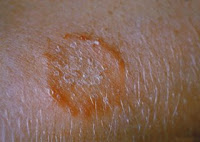 Although some experts consider ringworm as mild and harmless infection, ignoring it and hoping that somehow it would go away on its own, can be detrimental to your child's health or your's. In some instances, like in ringworm of the scalp (tinea capitis), which is most common in children, it could lead to permanent (and premature) hair loss and baldness. Ringworm treatment must be initiated as soon as you detect the ringworm. Failure to treat the infection can make it chronic, persistent, and more widespread – making it all the more difficult to treat later.
Ringworm, an infection caused by mold-like fungi known as dermatophytes (not by worms!), is so common that the Centers for Disease Control and Prevention (CDC) estimates that at any given time, approximately twenty percent of the population is affected by it. Before you start ringworm treatment at home, I suggest you make certain first that it is really ringworm you are dealing with and not other conditions that show similar symptoms. Please see Symptoms of Ringworm.
What does ringworm look like? What are the symptom of ringworm? To see pictures of ringworm please visit the page 'What does ringworm look like?' Take a few minutes to learn the facts before starting ringworm treatment. Ringworm has a distinctive appearance and quite easy to spot. It would appear as reddish circular lesion with healthy skin in the middle and raised scaly borders, usually 1/2 to 1 inch in diameter, or about the size of a dollar coin. If you're not sure, have a medical professional take a look at the lesion for accurate diagnosis of the symptoms.
Fortunately, ringworm is easy to treat and responds well to home care or personal care ringworm treatment. Using over-the-counter medications (you don't need a doctor's prescription to purchase any of these), you can start treating ringworm and expect the infection to be completely cured in 2-4 weeks.
In some instances, like in ringworm of the scalp (tinea capitis), an infection most common in children, it could lead to premature and permanent hair loss and baldness - something that could severely impact a child's self-esteem growing up. Failure to administer medication can make the infection chronic, persistent, and more widespread – making it all the more difficult to treat later.
Ringworm Treatment at Home
Fortunately, ringworm is easy to treat and responds well to home care or personal care treatment. Using common over-the-counter medications (you don't need a doctor's prescription to purchase any of these), you can start treating ringworm and expect the infection to be completely cured in 2-4 weeks.The most common over-the-counter topical agents (in cream, powder, or spray form) available are:
Tolnaftate (common brands: Tinactin®)
Miconazole (common brands: Monistat Derm cream, Micatin)
Clotrimazole (common brands: Lotrimin®, Cruex®, Desenex®)
Ketoconazole (common brands: Nizoral)
Terbinafine (common brands: Lamisil)
Thoroughly wash and clean the affected area. Allow it to dry. Then, apply a thin layer of the topical agent twice a day for at least two weeks, or according to package directions. Some doctors actually advise to also apply the cream one inch beyond the affected spot, just to arrest the spread of the infection. Continue with this regimen for at least two more weeks even if the infection appears to have dried up and vanished.
Infected pets should also be treated, if there are any. This is to prevent you or your child from getting infected again.
Before You Begin
What is ringworm? Ringworm is an infection caused by mold-like fungi known as dermatophytes (not by worms!). It is exceedingly common - the Centers for Disease Control and Prevention (CDC) estimates that, at any given time, approximately twenty percent of the population is affected by it. Before you start treating fungal infection at home, it is strongly suggested for you to confirm beforehand that what you're dealing with is indeed ringworm and not another condition that manifests similar symptoms.What does ringworm look like? What are the symptoms of ringworm? Is ringworm contagious? Take a few minutes to look at pictures of ringworm and learn the facts before starting any treatment regimen. Ringworm has a distinctive appearance and quite easy to spot. It would appear as reddish circular lesion with healthy skin in the middle and raised scaly borders, usually 1/2 to 1 inch in diameter, or a bit larger than a quarter. If you're not sure, have a medical professional take a look at the lesion for accurate diagnosis of the symptoms.
When To See a Medical Professional
Some fungus infections do not respond well to external applications. In fact, home care ringworm treatment, using the over-the-counter medications mentioned above, is ineffective in treating ringworm of the scalp and of the toenails. These types of infection attack the toenails and the scalp deep in the roots of the hair, and to penetrate these areas, oral medication, prescribed by a doctor may be necessary.See your doctor immediately, if ringworm of the body covers a large area, affects the scalp or nails, is severe, or doesn't respond to over-the-counter medication within 4 weeks of self-care.
Your doctor will recommend either prescription-strength topical (external) medication such as:
Econazole
Miconazole (common brands: Monistat, Micatin)
In most cases, the doctor will recommend oral medication like:
Griseofulvin (common brands: Grifulvin, Fulvicin, and Gris-PEG)
Terbinafine (common brand: Lamisil)
Itraconazole (common brands: Sporanox)
Fluconazole (common brands: Diflucan)
Known Side Effects
In taking oral medication to treat severe ringworm infection, the Mayo Clinic article cautions that "side effects from oral medications include gastrointestinal upset, rash and abnormal liver functioning. Taking other medications, such as antacid therapies for ulcer disease or gastroesophageal reflux disease (GERD), may interfere with the absorption of these drugs. Oral ringworm medications may also alter the effectiveness of warfarin, an anticoagulant drug that decreases the clotting ability of your blood."For years, when the only available medication for treating ringworm of the scalp and nails was Griseofulvin (common brands: Grifulvin, Fulvicin, and Gris-PEG) doctors often caution patients against these side effects of oral ringworm drugs. As a consequence, many patients until this very day, try to avoid using oral medication even if topical creams are shown to be ineffective in treating their scalp or nail infection.
The MedicineNet article however, observes that "in recent years, newer agents" for treating ringworm "have been introduced that are both safer and more effective. These include terbinafine, itraconazole , and fluconazole. Reputations die hard, however, and many people continue to fear that even these newer agents are 'bad for the liver,' when in fact they are quite safe when used properly" under the supervision of a medical professional.
Natural or Organic Remedies
An alternative method for ringworm treatment is the natural or organic method. This ringworm cure being harnessed by modern medicine in treating ringworm and other fungal and bacterial infections, uses one hundred percent organic plant extracts. One of these uses Tea tree oil extracts taken from the tea tree (Melaleuca alternifolia), a plant native to New South Wales in the north east corner of Australia. Many scientific studies have demonstrated that this is a very safe and effective ringworm remedy.If you are averse to taking oral medication, you might consider using natural treatment methods in dealing with ringworm of the scalp or nails. Tea tree has been known to be a powerful antifungal agent and can penetrate deeply-rooted infections like these.
Tea tree extract-based ringworm treatment is completely natural and organic. Unlike synthetic medications, it has minimal adverse side effects and is safe to use in treating ringworm externally in children and pregnant women. Of course, we each have our own physical peculiarities and for some people, natural may not always mean effective or safe. Like in any other medication or substance that you apply to your body, it is best to consult a medical professional before starting treatment and to follow product directions.
Ringworm Treatment: Prevention
Prevention is still the best ringworm treatment. However, according to the Mayo Clinic, ringworm is difficult to prevent. "The fungus that causes ringworm is common and contagious even before symptoms appear."
Stay clean. Hygiene is important in preventing the spread of ringworm in your household. Wash your hands often, and encourage your children to do the same, to avoid the spread of infection. Always keep your hands and feet clean and dry. Shampoo your hair regularly, especially after every hair cut. Wear shoes or sandals all the time at the gym, locker rooms, and pools. Use sanitizers and disinfectants to clean common or shared areas in your house, at school, in child care centers, gyms, locker rooms, and in areas where you keep your pet cats or dogs.
Stay cool and dry. Avoid excessive sweating, don't wear heavy clothing in warm, humid weather. Dr. Stoppler observes: " Common recommendations along these lines are for men to wear boxer shorts, for women to avoid panty hose, and so forth. Whether these measures, some of which are quite difficult to implement, are really worth all of the effort is open to question. One thing is sure though: white socks (which are often recommended for athlete's foot) are not necessary!"
Avoid infected animals. According to Dr. Stoppler, cats are the most commonly affected pets. Often they show skin changes similar to those of affected humans. Look out for bald spots or patches of skin where fur is missing. In some cats, however, the symptom may not be visible. If you're not sure, bring your cat to the veterinarian to check for ringworms. Infected dogs, on the other hand, generally always show the typical skin symptoms of ringworm.
Treat your pets of ringworm or have them checked by a vet if you're not sure. Remember, ringworm infection does not create lasting immunity and you can be infected with ringworm repeatedly through continued contact with infected pets.
Don’t share personal items. Don't let others use your personal items like clothing, towels, hairbrushes, combs, gloves, and headgear. Of course, you too must make it a point not to borrow those items from others. To be doubly safe, wash and dry these items after every use.
RELEVANT LINKS:
Doctor's Pulse by Dr. Melissa Conrad Stoppler. Topics range from bed bugs, bee sting treatment, spring cleaning tips, night sweats, sleep, stress buster tips, fitness tips and more.
MayoClinic.com, "Tools for Healthier Lives" medical resource service by the highly-respected Mayo Clinic in Rochester, Minnesota.
Below are some steps you can take to help reduce the risk of ringworm:
Be informed and inform others. Be aware of the risk of acquiring ringworm from infected persons and pets. Educate your children about ringworm, and tell them what to look out for, and how to avoid infection.Stay clean. Hygiene is important in preventing the spread of ringworm in your household. Wash your hands often, and encourage your children to do the same, to avoid the spread of infection. Always keep your hands and feet clean and dry. Shampoo your hair regularly, especially after every hair cut. Wear shoes or sandals all the time at the gym, locker rooms, and pools. Use sanitizers and disinfectants to clean common or shared areas in your house, at school, in child care centers, gyms, locker rooms, and in areas where you keep your pet cats or dogs.
Stay cool and dry. Avoid excessive sweating, don't wear heavy clothing in warm, humid weather. Dr. Stoppler observes: " Common recommendations along these lines are for men to wear boxer shorts, for women to avoid panty hose, and so forth. Whether these measures, some of which are quite difficult to implement, are really worth all of the effort is open to question. One thing is sure though: white socks (which are often recommended for athlete's foot) are not necessary!"
Avoid infected animals. According to Dr. Stoppler, cats are the most commonly affected pets. Often they show skin changes similar to those of affected humans. Look out for bald spots or patches of skin where fur is missing. In some cats, however, the symptom may not be visible. If you're not sure, bring your cat to the veterinarian to check for ringworms. Infected dogs, on the other hand, generally always show the typical skin symptoms of ringworm.
Treat your pets of ringworm or have them checked by a vet if you're not sure. Remember, ringworm infection does not create lasting immunity and you can be infected with ringworm repeatedly through continued contact with infected pets.
Don’t share personal items. Don't let others use your personal items like clothing, towels, hairbrushes, combs, gloves, and headgear. Of course, you too must make it a point not to borrow those items from others. To be doubly safe, wash and dry these items after every use.
RELEVANT LINKS:
Doctor's Pulse by Dr. Melissa Conrad Stoppler. Topics range from bed bugs, bee sting treatment, spring cleaning tips, night sweats, sleep, stress buster tips, fitness tips and more.
MayoClinic.com, "Tools for Healthier Lives" medical resource service by the highly-respected Mayo Clinic in Rochester, Minnesota.
Subscribe to:
Comments (Atom)